Buying a Loft in DUMBO’s Waterfront: Loft or Condo?
April 16, 2026
April 16, 2026
Wondering whether DUMBO’s waterfront is the right place for your next home? If you are weighing a loft against a newer condo tower, this is one of those Brooklyn decisions where the details really matter. From ceiling height and light to monthly carrying costs and weekend foot traffic, the right fit depends on how you want to live. Let’s dive in.
DUMBO remains one of Brooklyn’s most expensive submarkets, with a median sale price of $1.7 million, median base rent of $5,795, and 62 median days on market. That tells you two things right away: buyers are paying a premium for the location, and they are still making selective, careful decisions.
The waterfront is a big part of the appeal. Brooklyn Bridge Park is open daily from 6 a.m. to 1 a.m. and offers public art, athletic areas, playgrounds, and recurring events. For you as a buyer, that means easy access to one of Brooklyn’s signature outdoor amenities, along with the public activity that comes with it.
Transit is also workable, though it is very block-specific. Current DUMBO listings place many waterfront homes about 0.2 to 0.3 miles from the A/C at High Street, the F at York Street, the 2/3 at Clark Street, and the Fulton Ferry landing, with added access to Borough Hall and Court Street connections in some cases, as shown on current Olympia listing details.
In DUMBO, the biggest decision often is not just price. It is whether you want industrial character or a more contemporary full-service living experience.
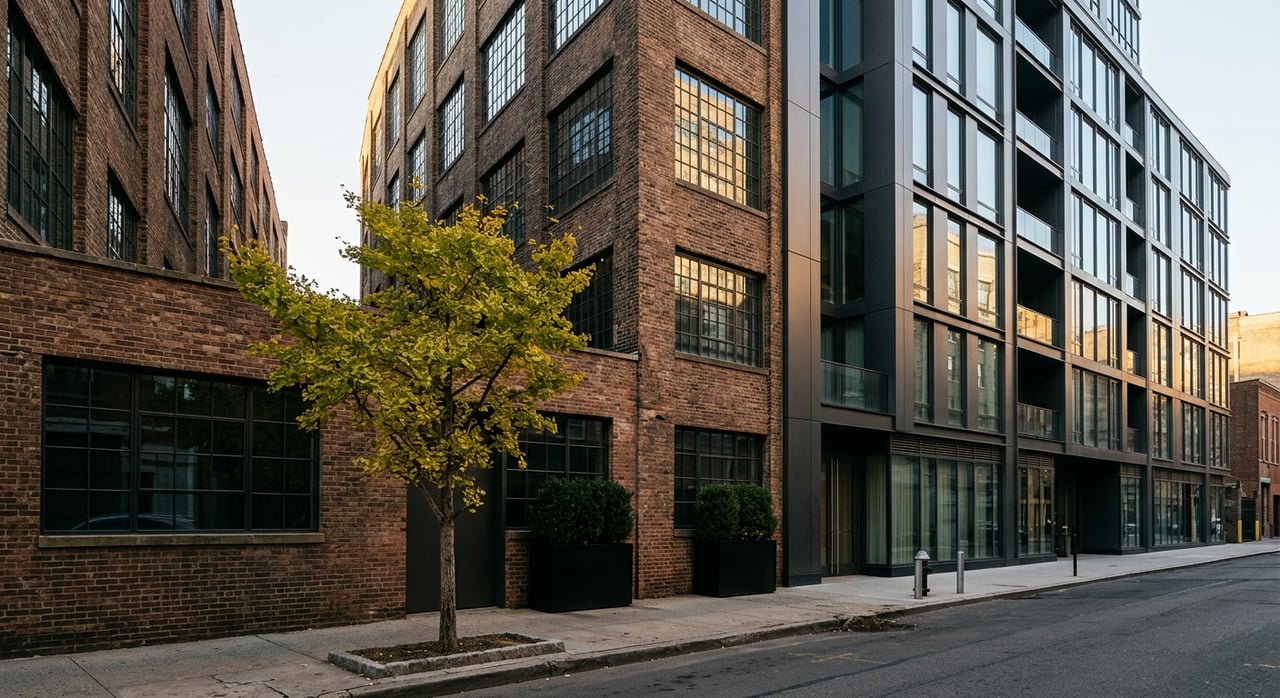
Older loft buildings reflect the neighborhood’s manufacturing past. According to a NYC Planning overview of DUMBO, many of the area’s industrial buildings were originally designed with tall windows and strong streetline massing to bring daylight into workspaces. As the neighborhood evolved, many of these buildings were converted to residential use.
That legacy still shows up in today’s loft inventory. The Clocktower at 1 Main Street is a 1916 condo building with 124 units, oversized windows, and roughly 11-foot ceilings, according to current Clocktower listing information. Kirkman Lofts at 37 Bridge Street was converted from a soap factory and now has 45 units. At 168 Plymouth, two historic factory buildings were combined into 46 residences with brick-and-timber and daylight-factory loft features.
Newer condo towers offer a different package. Olympia at 30 Front Street is a 33-story, 76-unit condo completed in 2024 with more than 38,000 square feet of amenities, including indoor and outdoor pools, a tennis court, a gym, and full-time doorman and concierge service. Front & York at 85 Jay Street is another major newer building, with 407 units across 21 stories and a 2021 completion.
A loft in DUMBO often appeals to buyers who want:
The tradeoff is that layouts can feel less standardized. Storage, room shapes, and furniture placement may require more thought than in a newer tower.
A newer waterfront condo often appeals to buyers who prioritize:
That convenience can come with noticeably higher monthly carrying costs. In DUMBO, those differences can be significant.
One of the most important things to understand about DUMBO is that pricing is stratified, not simple. You are not just paying for old versus new. You are often paying for a mix of views, architecture, amenities, layout quality, and building identity.
CityRealty data for current and recent sales shows active listing averages around $1,544 per square foot at the Clocktower, $1,624 per square foot at Kirkman Lofts, and $2,266 per square foot at Olympia. Recent sales averages were about $1,434, $1,191, and $2,446 per square foot, respectively.
Premium loft product can also command very high pricing. The same source notes that 168 Plymouth has an active penthouse listing at $2,611 per square foot. In other words, exceptional loft inventory can compete directly with, or exceed, newer tower pricing.
Purchase price is only part of the story. In DUMBO’s waterfront district, common charges and taxes can vary sharply from one building to another.
A 1,293-square-foot Clocktower loft currently shows monthly common charges of $689 and taxes of $778, based on Clocktower listing details. By comparison, a 1,326-square-foot two-bedroom at Olympia shows monthly common charges of $1,708 and taxes of $2,303.
Another Olympia one-bedroom at 877 square feet shows $1,123 in monthly common charges and $1,520 in taxes. At the high end, 168 Plymouth’s penthouse shows monthly common charges of $5,684 and taxes of $6,416. These numbers make one point very clear: the real monthly cost of ownership may look very different from one building to the next, even within the same neighborhood.
Light is a major reason buyers are drawn to DUMBO lofts. The neighborhood’s industrial buildings were designed to pull in daylight, and that design history still shapes many current homes, as noted in the NYC Planning materials on DUMBO.
Still, no building type guarantees the same living experience. Actual light depends on exposure, floor height, and what sits across the street or toward the bridge. A loft with dramatic windows may still feel different from one line to another in the same building.
Views can also be a major value driver. Waterfront towers like Olympia market harbor, skyline, and water views, while older loft buildings such as the Clocktower and Kirkman also promote East River and Manhattan Bridge views through active listing materials. If views are central to your purchase, unit-level analysis matters more than building reputation alone.
The daily feel of DUMBO’s waterfront can shift more than buyers expect. Because Brooklyn Bridge Park is open until 1 a.m. and hosts public programming, and because StreetEasy notes the area’s ongoing appeal for views, galleries, and restaurants, nearby blocks can experience regular visitor traffic.
That is not necessarily a negative. For many buyers, the energy is part of the appeal. But if you are sensitive to noise, crowds, or evening activity, you should walk the block during the day, after work, and on a busy weekend before making a decision.
If you are buying in a converted building, it is smart to understand exactly what kind of property you are purchasing. DUMBO includes standard condominiums, converted loft condos, and a limited number of properties that may still involve NYC Loft Board considerations.
The Loft Board notes that coverage depends on factors such as prior commercial, manufacturing, or warehouse use and whether a residential certificate of occupancy was absent. That does not mean every older loft building presents the same regulatory questions. It does mean you should ask clear due diligence questions early, especially if you are drawn to a less conventional property.
Before you choose a loft or condo in DUMBO’s waterfront district, focus on a few practical questions:
These are the questions that often shape buyer satisfaction long after the closing date.
In a neighborhood like DUMBO, the best purchase is rarely about checking the most boxes on paper. It is about matching the property to your priorities with clear eyes. A loft may give you volume, texture, and a strong sense of place, while a tower may offer ease, services, and a more turnkey ownership experience.
If you are comparing properties in DUMBO’s waterfront district, it helps to work with an advisor who understands not just pricing, but also conversion history, building differences, and how architecture shapes value. If you would like a more tailored view of which buildings and unit types fit your goals, Donald Brennan can help you evaluate the tradeoffs with a technical, neighborhood-informed perspective.
Stay up to date on the latest real estate trends.
October 15, 2026
October 8, 2026
October 1, 2026
September 24, 2026
September 17, 2026
September 10, 2026
September 3, 2026
August 27, 2026
August 20, 2026