Downtown Brooklyn's Next Two Food Halls Aren't Open Yet, and the Old One Is Already Half Empty
September 10, 2026
September 10, 2026
Two of the biggest dining announcements in Downtown Brooklyn this year won't feed anyone until 2027. Casa Tua Cucina, the elevated food hall planned for the marble banking hall inside the old Williamsburgh Savings Bank Tower, and Din Tai Fung, the Michelin-starred dumpling house signed for the ground floor of The Brook, are both still leases and renderings. Meanwhile the food hall that's actually open right now, DeKalb Market Hall, has quietly lost more than half of its original vendors since it debuted in 2017. If you've been reading the headlines and wondering where to eat tonight, the headlines aren't going to help you.
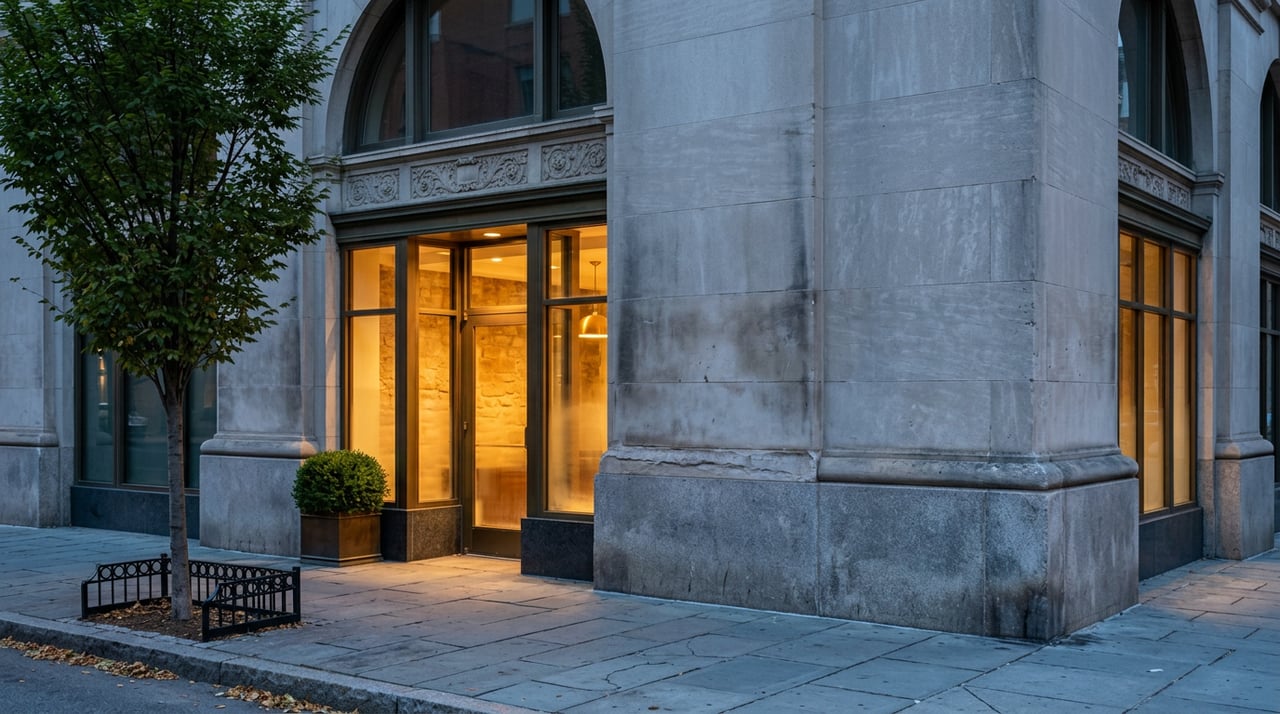
Start with the tower. Brooklyn Sports & Entertainment, which owns the Barclays Center, bought the ground floor, mezzanine, and basement of One Hanson Place in 2024. The building itself, completed in 1929 and designed by Halsey, McCormack & Helmer, held the title of Brooklyn's tallest structure for 80 years until 2009, and its cathedral-scaled banking hall has sat mostly dormant since the Brooklyn Flea used it for weekend markets and film shoots. BSE has now partnered with Miami hospitality brand Casa Tua to convert that hall into what the company is calling an elevated food and beverage court, with a large central bar and lounge under the original marble and ironwork. Casa Tua cofounder Miky Grendene described the approach this way:
"One Hanson Place is a remarkable, historic setting, and with Brooklyn Sports & Entertainment, we share a clear vision for how to approach it: with the utmost respect for the landmark building, the neighborhood, and the people who will bring it to life every day."
The Landmarks Preservation Commission signed off on the design earlier this year, which clears the legal hurdle. The opening date is still 2027.
A few blocks away, Din Tai Fung has taken 20,000 square feet on the ground floor of The Brook, the 52-story residential tower at 567 Fulton Street. It's the chain's second New York location after its Midtown debut in 2024, and it will be smaller than that first restaurant by about a quarter. The lease was brokered through Newmark and GoodSpace, and neither side has disclosed the rent, though average retail asking rents in Downtown Brooklyn during the first half of 2025 ran as high as $190 per square foot on Fulton Street, well above the roughly $115 seen on Court Street. That gap is one reason national brands keep planting flags specifically on Fulton rather than spreading evenly across the neighborhood. Din Tai Fung's target opening is also 2027.
Both projects are real. Both are worth being excited about. Neither one solves the question of what to eat this Thursday.
DeKalb Market Hall, tucked into the basement of City Point at 445 Albee Square West, is the one that's been feeding Downtown Brooklyn since 2017. Food critic Robert Sietsema revisited the hall in April 2026 for a series on food courts and found a much thinner lineup than the one that opened it. Of the original twelve counters, seven are gone: Arepa Lady, Fletcher's BBQ, Steve's Key Lime Pies, Wilma Jean Fried Chicken, Bunker Vietnamese, Lioni Brooklyn Italian Heroes, and Ample Hills Ice Cream all closed their stalls. Some newer arrivals have filled the gaps, including Hainan Jones, a Singapore hawker stand that migrated over from Midtown's Urban Hawker and serves a steamed or roasted chicken plate with broth, rice, and two sauces for $17.50.
The hall still has real draws. It's the first Brooklyn outpost for Katz's Delicatessen, and it hosts a Night Market on the last Friday of most months with live entertainment from local partners like Soul Summit. But the turnover Sietsema documented is the kind that happens to food halls once the opening-day novelty wears off and rent economics force out anyone who can't keep pace. Nine years is a long time for a food court to run without a full refresh, and DeKalb hasn't had one.
Not every food hall in the neighborhood is thinning out. Gotham Market at The Ashland, at 590 Fulton Street on the Fort Greene border, is moving in the other direction. Sichuan and dim sum restaurant Breeze just signed a 15-year lease there for 3,600 square feet, joining existing tenants Peaches Prime and Fulton Hall. A 15-year commercial lease is not the kind of bet an operator makes on a food hall that's losing momentum. It's the kind of lease that assumes the location holds its audience for a decade and a half.
Part of that audience is built in. Gotham Market sits within walking distance of BAM's Harvey Theatre and Opera House, Theatre for a New Audience, and the Mark Morris Dance Center, and Peaches Prime has said openly that part of its draw is the pre-and-post-show crowd from those venues. That's a fundamentally different customer base than the lunch-rush, subway-transfer traffic that built DeKalb Market Hall's original identity. One food hall is built around a captive daytime population moving between office towers and transit. The other is built around people who already have a reservation somewhere else that night and need dinner before or after it.
If you want a food hall experience in Downtown Brooklyn right now, DeKalb Market Hall still delivers volume and variety, but go in knowing the lineup has shifted since it opened and some of what made it a destination in 2017 isn't there anymore. If you're catching a show at BAM, Gotham Market at The Ashland is the newer bet, with a roster that's still filling in and a landlord clearly confident enough to sign long leases on it. And if you're the type who marks a calendar for restaurant openings two years out, both Casa Tua Cucina and Din Tai Fung are worth that patience, but neither one is a plan for this weekend.
What ties all four of these together is timing, not competition. Downtown Brooklyn isn't choosing between four food halls fighting over the same lunch crowd. It's running two different clocks at once: one hall losing vendors in real time, one hall gaining long-term tenants in real time, and two much larger projects still measured in years rather than months. Reading the headlines without knowing which clock you're on is how you end up standing outside a marble banking hall in 2026 wondering why the door won't open.
There's something fitting about a 1929 bank building becoming the neighborhood's most anticipated restaurant project. The people who designed banking halls in that era built them to make every visitor feel like they'd arrived somewhere important, and that instinct doesn't disappear just because the tellers are gone. Buildings like One Hanson Place carry their original intentions in the stone and ironwork long after their original use ends, which is exactly the kind of adaptive reuse question Brennan Global Properties spends its time thinking through for owners and developers working with Brooklyn's landmarked stock. If you're weighing what a historic interior in this neighborhood can become next, whether it's a banking hall, a rowhouse parlor floor, or a conversion project of your own, schedule a private consultation and let's talk through what the building actually allows.
Stay up to date on the latest real estate trends.
September 17, 2026
September 10, 2026
September 3, 2026
August 27, 2026
August 20, 2026
August 13, 2026
August 13, 2026
August 6, 2026
July 23, 2026